
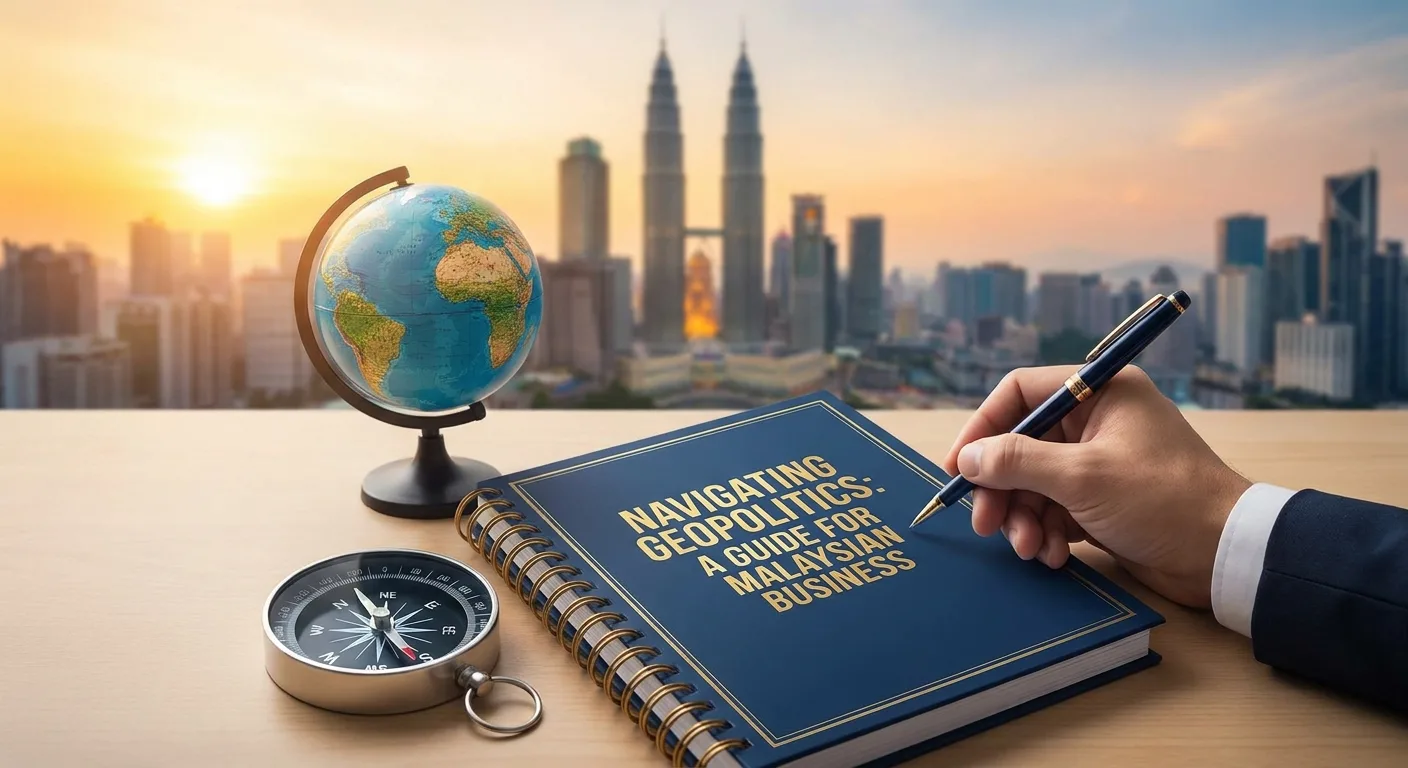
Navigating Geopolitics: A Guide for Malaysian Business
The global economic stage is being reshaped before our very eyes. Gone are the days of predictable trade winds and calm commercial waters. Today, we’re navigating a more turbulent sea, where the currents of competition between the world’s major powers are growing stronger. The long-standing influence of the West, led by the US and EU, is now being met with a confident and coordinated push from the BRICS nations – Brazil, Russia, India, China, and South Africa. This dynamic is creating a new and complex global chessboard. For business leaders here in Malaysia, simply observing from the sidelines is not an option. Understanding this shifting geopolitical landscape is now a fundamental part of strategic planning and securing future growth.
The New World Stage: West vs. BRICS
At the heart of today’s global friction is a fundamental contest over economic and political influence. We are seeing this play out in several ways. The West often uses tools like sanctions and trade tariffs to uphold a rules-based international order, as seen in the ongoing trade disputes with China or the economic measures against Russia. In response, the BRICS countries are actively building parallel systems. They are increasing trade in their local currencies to reduce reliance on the US dollar and have established institutions like the New Development Bank as an alternative to the World Bank and IMF. This isn’t just political posturing; it represents a tangible shift in global power dynamics that affects supply chains, financial flows, and market access for everyone.

The Ripple Effect on Malaysian Commerce
For a trading nation like Malaysia, these global tensions are not distant news headlines; they are direct business realities. The challenges are clear. A company relying on a component from a nation that suddenly faces sanctions could see its entire production line halt. The constant back-and-forth on tariffs can make pricing and forecasting a nightmare. However, with challenge comes opportunity. As multinational corporations look to de-risk their operations and diversify away from single-country dependence (often referred to as a “China+1” strategy), Malaysia stands out as a stable, neutral, and attractive hub for manufacturing and services. We can attract significant trade and investment by positioning ourselves smartly as a reliable partner to all sides.
Learning from India’s Balancing Act
To see how this can be done, we can look at India. It is a core member of BRICS and a key participant in its initiatives. At the same time, India is also a member of the Quadrilateral Security Dialogue (Quad) alongside the US, Japan, and Australia, a partnership widely seen as a counterbalance to China’s influence. By engaging with both blocs, India carefully navigates the landscape to maximise its own national interest. This balancing act provides a valuable lesson for Malaysia. It shows that it’s possible to maintain strong economic ties with diverse partners, leveraging opportunities wherever they arise without being forced to pick a side. This agility is a powerful tool for resilience.

Strategic Navigation for the Modern Malaysian Business
So, how can we actively steer our businesses through these waters? It begins with being proactive. We must closely monitor shifts in global power dynamics, paying attention to policy changes in Washington, Brussels, and Beijing alike. The next step is to assess the potential impact. Does a new trade agreement open up a market for our products? Does a new sanction threaten a key supplier? Running these scenarios helps turn uncertainty into a manageable plan. This is also the time to aggressively explore new emerging market opportunities, particularly in fast-growing regions within ASEAN, Africa, and Latin America that may be less affected by the major power rivalries. A robust risk mitigation plan, built on diversifying suppliers, markets, and financial holdings, is no longer a ‘nice-to-have’—it’s essential for survival and growth.
Ultimately, the era of passive business strategy is over. The growing friction between global powers has created a volatile but opportunity-rich environment. For Malaysian businesses, success will be defined by agility, awareness, and the courage to adapt. This means actively seeking to understand the complex forces at play, from trade policies to diplomatic shifts, and building resilience into every facet of our operations. By embracing a proactive approach—diversifying our partnerships, strengthening our supply chains, and pursuing strategic risk mitigation—we can do more than just weather the storm. We can harness the winds of change to sail towards new horizons of growth and position ourselves as key players in the evolving global economy. The future belongs to those who prepare for it today.